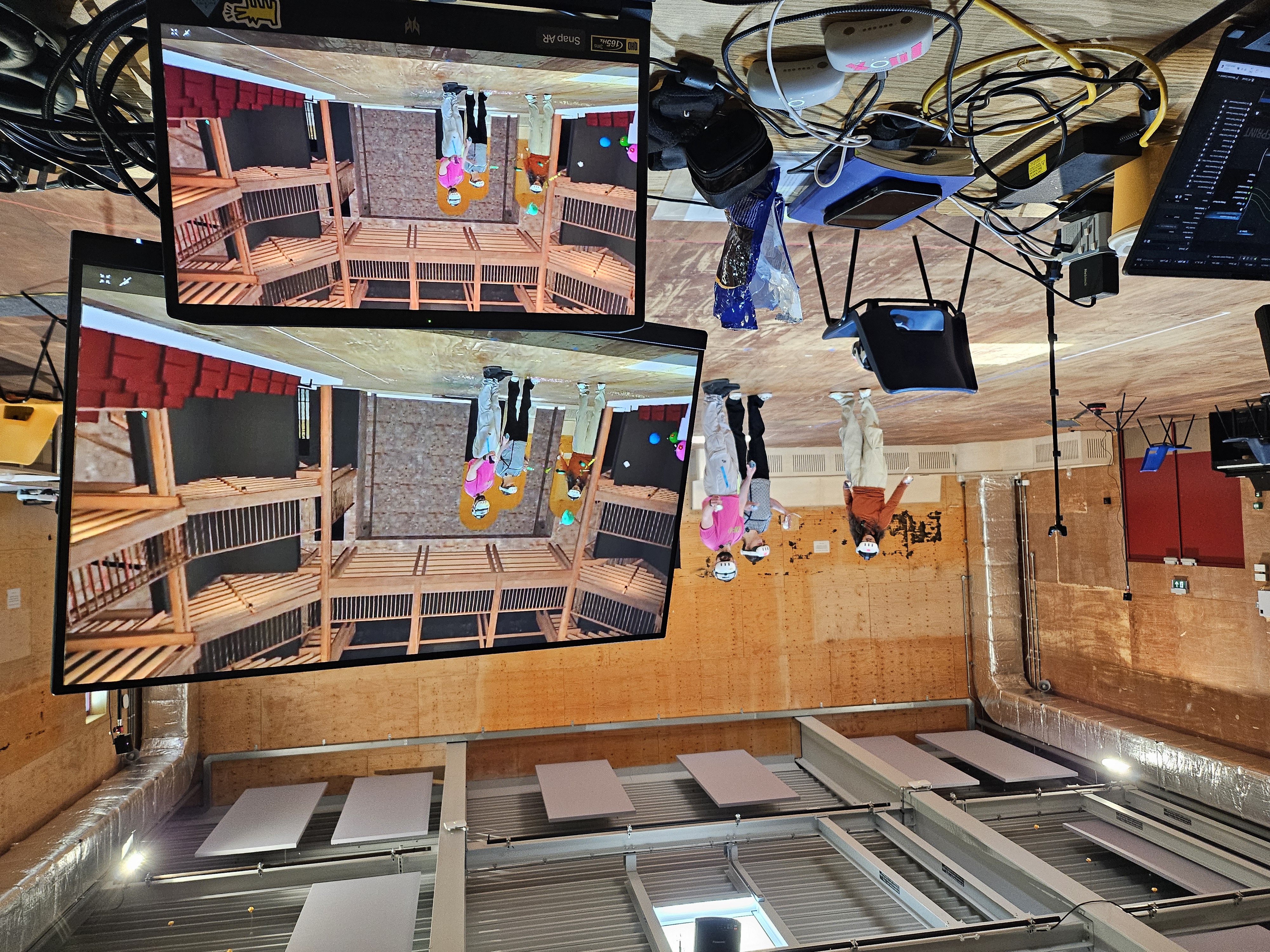
When entertainment companies discovered virtual reality as a new platform, numerous film producers rushed to embrace this new medium. What they failed to realise was that, in virtual reality, attention is not directed in the same way as in film. VR bears far more similarities to theatre.
Whilst in cinema the camera guides the eyes of the viewers, in the virtual world the user’s attention must be deliberately directed. Just as on stage, techniques such as lighting and movement must be utilized to ensure that the audience’s gaze is drawn to what is essential. However, if the audience is looking in a completely different direction, visual spotlights are ineffective. That is why spatial audio is indispensable. Without it, directing the focus of attention becomes difficult, immersion is lost, and the magic of the theatre evaporates.
That’s something the team at Agile Lens is well aware of. That’s why they combine theatre and virtual reality to create live VR experiences.
From architecture to VR entertainment
This New York-based company is not simply a VR start-up, but a studio with theatre DNA. It began as a project within the theatre planning and design consulting firm Fisher Dachs Associates, which specialises in the planning and design of theatres worldwide. The team led by Alex Coulombe, nowadays founder of Agile Lens and former theatre architect, used the technology to create 3D visualisations, check sightlines and simulate complex stage set-ups. In this way, plans were transformed into immersive virtual spaces.
In 2016, Alex went on to establish Agile Lens alongside his former boss, Joshua Dachs, spinning it off from the architectural practice. The aim was to utilise VR technology for architecture and live entertainment. In doing so, he expanded both aspects of the previous approach: architecture beyond the theatre, and theatre productions that do not revolve solely around architecture.
Today, Alex’s team is proving that VR is more than just a technical gimmick; it is a new form of media. One that captures the essence of theatre and transports it into virtual space. Theatre is thus enriched with a new dimension.
Kevin Laibson, Experience Director and Producer at Agile Lens, puts it this way: “Theatre is the activation of space. It’s about how we move through space, how we use it to tell stories. And that’s exactly what we can reproduce in VR, just using different means.”
A classic takes the virtual stage
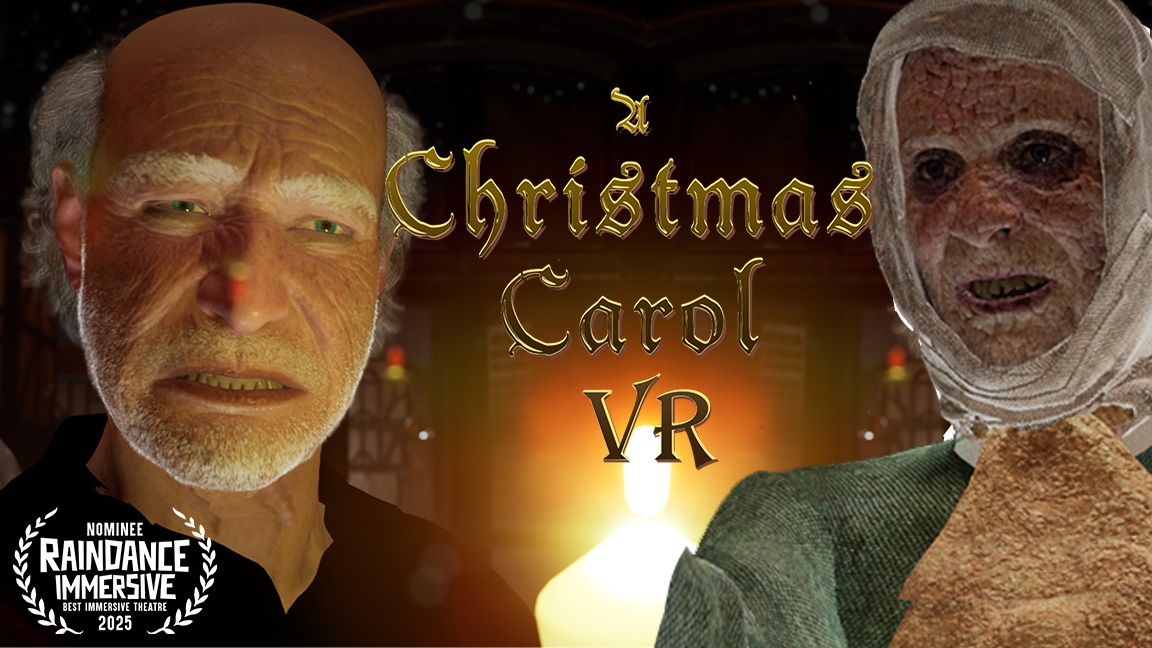
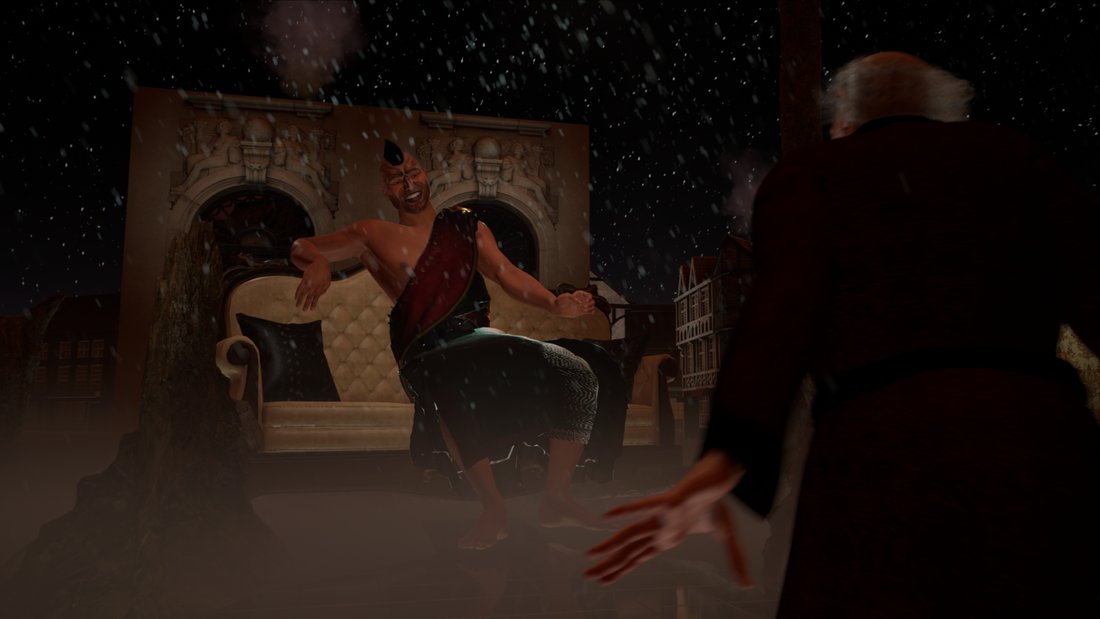
One of their most pioneering productions until today is A Christmas Carol. Charles Dickens’ story of the tight-fisted Ebenezer Scrooge, who transforms overnight from a misanthrope to a philanthropist, is one of the best-known tales in literature and theatre. In 2021, the Actors Theatre of Louisville approached Agile Lens with the idea of bringing the Christmas classic to the virtual stage as an interactive VR experience – inspired by a casual encounter two years earlier at the Theatre Communications Group (TCG) conference in Miami.
Robert Barry Fleming, artistic director of the Actors Theatre of Louisville, was fascinated by the possibilities of VR, and when the pandemic brought the theatre world to a standstill, the specific challenge arose: how could we return to live performances with a one-man production of A Christmas Carol?
Agile Lens knew the answer and adapted the play for virtual reality. Spectators could join in live using their own VR headsets, allowing them to experience the performance at a level of intimacy never seen before. The first version was a huge success, and so new productions were added year after year. The technology was improved, and the virtual characters moved more naturally. But one hurdle remained: audio.
Agile Lens used Agora for the actors’ audio transmission. However, the team soon realised that the solution wasn’t quite right. “It sounded like something optimised for games like Battlefield,” says Alex, describing the problem, “not for a theatrical performance.” In an environment where attention is guided not by a camera but by space, light and sound, this was a crucial shortcoming. “You can’t have a three-dimensional experience with two-dimensional sound,” concludes Kevin. “It feels uncanny and wrong. The sense of presence simply disappears.”
Finding the perfect voice solution
And even the actors realised that the voice solution wasn’t ideal. Debbie Deere, in particular, who played all the ghosts in A Christmas Carol, was unable to use her voice in the same way she would have on a real stage. “Debbie does this incredibly dynamic character work, particularly through her voice,” explains Yu-Jun Yeh, XR Creative Technologist at Agile Lens. “But as long as the audio system couldn’t convey those nuances, part of the performance fell by the wayside.”
Then, in 2023, a team member discovered ODIN Voice. Within a short space of time, the team set up an initial proof of concept, and it quickly became clear: this was the missing piece. Moreover, it was very easy to integrate. Jun, who was responsible for the technical implementation, recalls: “The very first stand-up of ODIN Voice was very quick. We spent only two or three days on the initial setup. And then we started using it in rehearsals straight away – it was the most stable part of our technical rehearsals.”

ODIN Voice: Revolutionizing immersive theatre in VR
But it was not simply the velocity that was so compelling. It was the quality of the immersion: actors could now use their voices in a way that did justice to the theatre. “It’s something that might even be subconscious to most people,” explains Alex, “but it objectively enhances the experience of the show. When the audio is right, you don’t notice it – but when it’s wrong, everything feels off.”
A particularly striking example are the scenes in which Ari Tarr switched between the roles of Ebenezer Scrooge and Charles Dickens. Thanks to ODIN Voice, his voice could move with spatial precision between the two avatars – even whilst he himself remained physically in the same spot. Kevin, who co-led the project’s artistic direction, recalled the moment when the team had finally fine-tuned the audio solution to perfection: “This was a great example of ‘We didn’t realise how far from excellent this was.’ As soon as the audio locked in, this whole mechanic opened up. The value of the show increased tenfold when we got spatial audio working. You could hear the voice travelling from one avatar to the other in a really exciting way.”
But the positioning of the characters was only one thing that brought the virtual theatre to life; it also allowed the actors themselves to perform their roles with greater authenticity. “Debbie’s performance really came into its own once we could rely on the audio solution to convey all the subtleties and nuances,” explains Jun. “She was making these incredible vocal choices, and with ODIN, we knew the audience would hear every single detail.”
Stage Presence: The Theatre of the Future
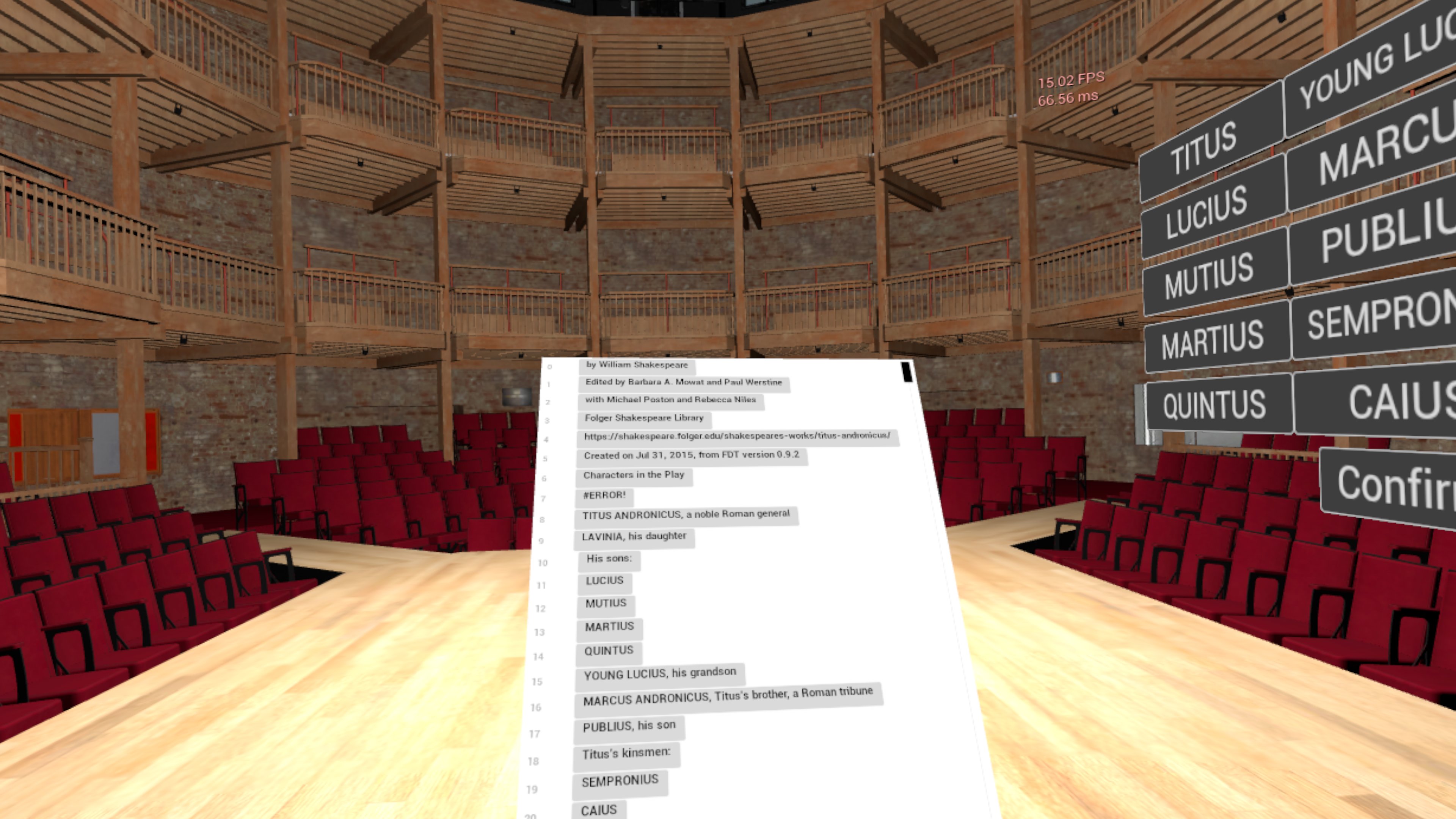
With A Christmas Carol, Agile Lens has proven year after year that VR and theatre need not be contradictory. But that was just the beginning. The Stage Presence platform, which emerged from the experience gained with the Christmas classic, became the foundation for future projects. Whether it’s new plays or fan experiences such as a Star Wars: Galactic Starcruiser adaptation – an open-source community project based on Stage Presence – ODIN Voice is now an integral part of the Agile Lens toolbox.
This technology has not only transformed the way Agile Lens stages theatre. It has also demonstrated that audio is not a secondary feature, but the key to immersion. Without it, VR remains an empty shell. With it, it becomes the stage of the future. And whilst Agile Lens continues to work on new projects, one thing is clear: the art of directing attention has found a new home in the virtual world.
So what’s next? Alex’s team at Agile Lens will continue to expand and take on new, even more ambitious projects. One thing is certain: ODIN Voice will play a central role in this – as the invisible yet indispensable entity that brings the magic of theatre into the virtual world.
Want to create real presence with voice?
Integrate immersive voice chat in hours that will fill your virtual world with life and create a compelling experience.